Spotify’s global reach has given African artists access to international audiences, but a closer look at the platform’s legal terms reveals clauses that could undermine creators’ rights in subtle yet significant ways.
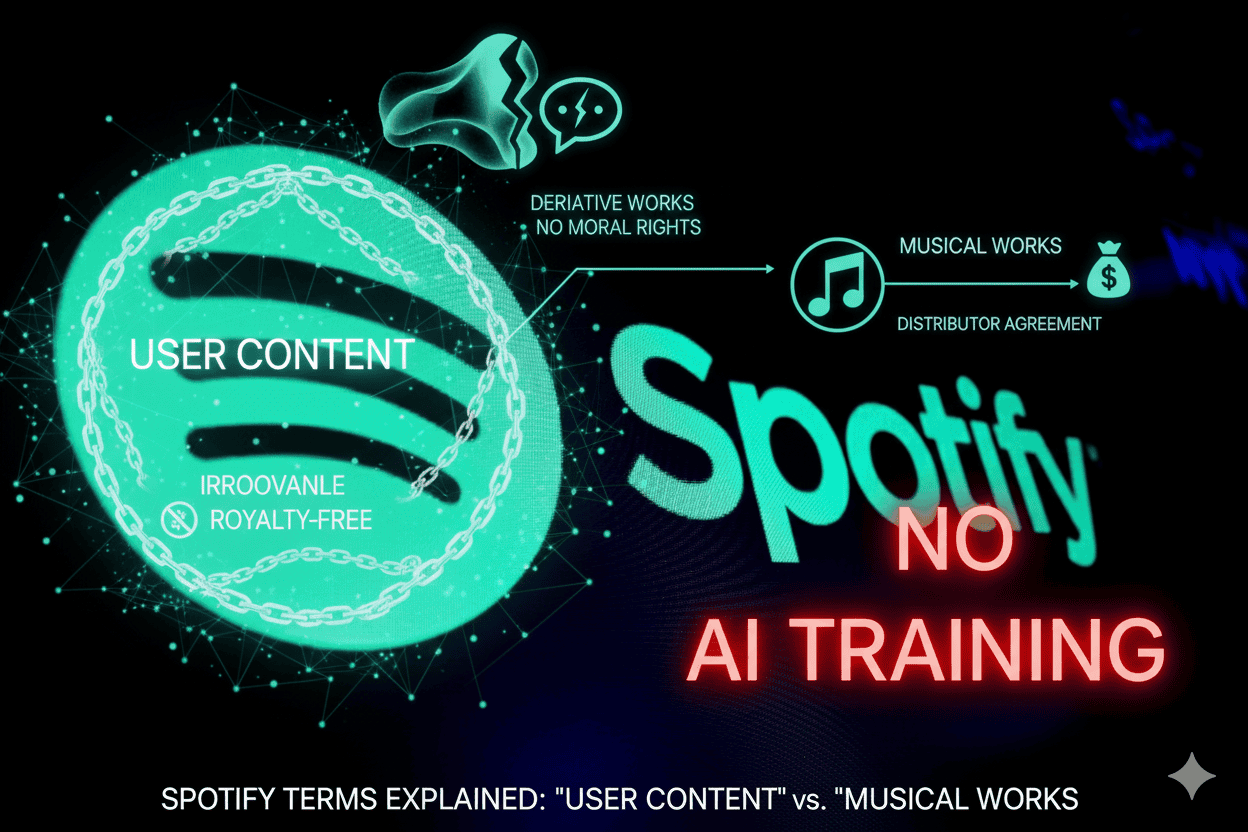
A detailed review of Spotify’s terms of use shows that while royalties for music streams are covered under separate agreements with distributors or record labels, the platform’s licensing of “User Content”—such as profile photos, playlist covers, descriptions, and promotional materials—raises red flags.
The Hidden Clause
Spotify grants itself an “irrevocable, non-exclusive, transferable, sub-licensable, royalty-free, fully paid, worldwide license” to use all user content. In practice, this allows the company to:
- Share user-generated content with third parties.
- Modify or adapt content, including for AI purposes.
- Retain rights to use content even after an account is deleted.
The most troubling element, experts say, is the waiver of moral rights, which strips creators of the right to be credited for their work or to prevent its distortion.
An Unequal AI Bargain
Industry observers argue that these terms create an “AI asymmetry.” Spotify can freely mine user data and behavior to train its machine learning tools, while third parties are explicitly banned from scraping data for similar purposes.
“Artists are effectively providing the fuel for Spotify’s AI without any say in how it’s used—or any share in the value created,” notes one analyst.
Kenyan Law: What Protections Exist?
Under the Kenya Information and Communications Act (KICA), online contracts are enforceable once a user clicks “I agree.” However, the Consumer Protection Act could provide a basis for challenging clauses deemed unfair or unconscionable, such as the waiver of moral rights.
That said, mounting a legal challenge against a global platform remains costly and complex, leaving individual creators with little leverage.
Why It Matters for Africa
For Africa’s fast-growing creative economy, the Spotify debate highlights a bigger question: how much control do artists really have over their work once they engage with global platforms?
As one Nairobi-based lawyer told Data Governance Africa, “The law is still catching up. Until then, creators need to be aware of what they’re signing away in the fine print.”
With streaming platforms shaping the future of music, the balance of power between tech giants and African creators may define the next chapter of the continent’s digital economy.