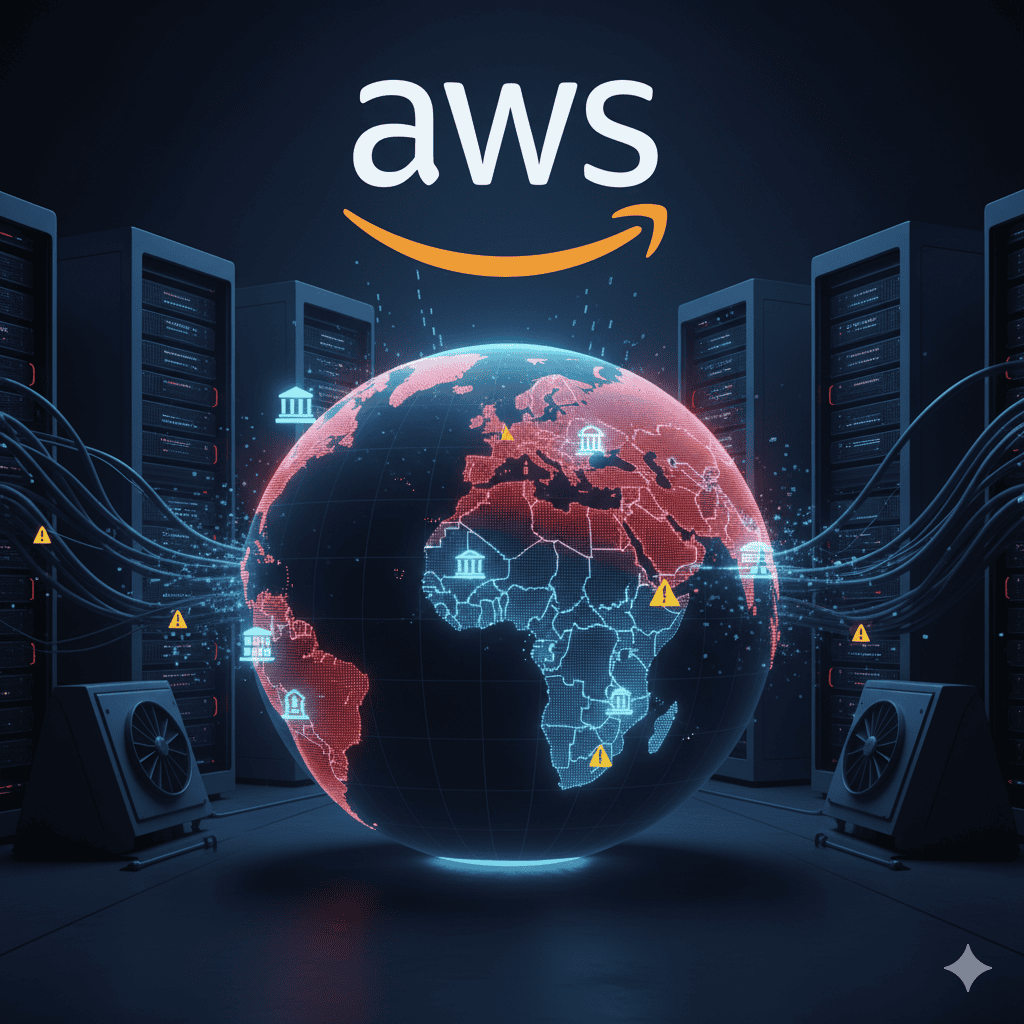
Monday, October 20, 2025, marked one of the largest global internet disruptions in recent memory, after a massive outage hit Amazon Web Services (AWS), the cloud backbone behind thousands of platforms worldwide. The incident, which originated in the US-EAST-1 region in Northern Virginia, disrupted major sectors from finance to government services, exposing once again the risks of centralization in the cloud computing ecosystem.
What Happened
The outage began around midnight PST (10 AM EAT) and was traced to a DNS resolution failure affecting the DynamoDB API endpoint in the affected region. DynamoDB underpins numerous AWS and customer services; its failure triggered a chain reaction impacting EC2, Lambda, CloudWatch, and IAM, which are core infrastructure on which countless digital applications depend.
Global Impact
The scale of the disruption was immense. Over 60 major services were reported down or severely degraded, including:
- Gaming: Fortnite, Roblox, PlayStation Network, Prime Video, PUBG Corporation
- Finance: Robinhood, Coinbase, Venmo, Chime, Lloyds Banking Group
- Social Media: Snap Inc., Reddit, Signal, X (Twitter)
- Productivity: Canva, Duolingo, Zoom, Slack, Airtable
- Amazon Services: Alexa, Ring, and Amazon.com itself
- AI & Tech: Perplexity AI, The New York Times, McDonald’s App, Strava
- Government: UK’s HMRC and related public systems
AWS began showing “significant signs of recovery” after about three hours, but some systems remained unstable for over 15 hours. Analysts have described the outage as the largest internet disruption since the 2024 CrowdStrike incident.
Implications for Africa’s Digital Future
For Africa’s rapidly growing digital economies, many of which rely on AWS or similar hyperscalers, the outage is a stark reminder of concentration risk. A technical fault thousands of miles away can ripple across borders, halting services, payments, and public platforms in regions with little to no control over recovery processes.
African regulators and enterprises are now faced with a critical governance question: how can nations balance the efficiency of global cloud providers with the need for data sovereignty and operational resilience?
Local cloud infrastructure, hybrid models, and regional redundancy strategies could help mitigate these risks. However, they require coordinated investment and clear policy frameworks that promote digital sovereignty without isolating African markets from global innovation.
Expert Recommendations
This incident underscores the need for transparency in cloud dependency. Independent auditing mechanisms, clearer service-level visibility, and regional fallback strategies should form part of every critical system’s resilience plan. African enterprises and regulators are encouraged to treat cloud dependency as a strategic governance issue rather than a purely technical one.
Conclusion
The October 20 AWS outage serves as both a warning and an opportunity, a warning of over-centralization and an opportunity for African policymakers, cloud providers, and businesses to rethink the architecture of digital resilience.