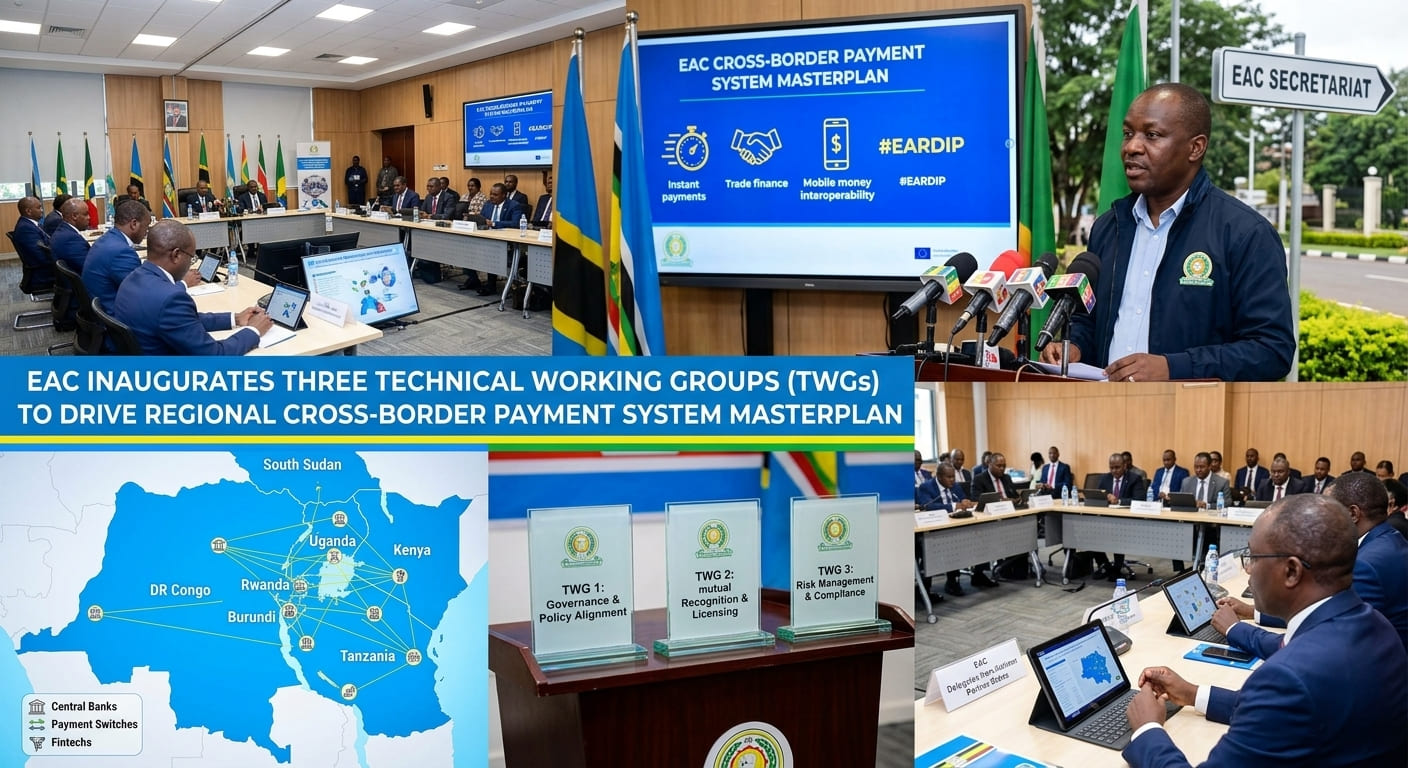
The East African Community (EAC) is taking another significant step towards making cross-border digital payments more seamless, interoperable and secure.
The EAC Secretariat has inaugurated three Technical Working Groups (TWGs) to drive the operational implementation of the EAC Cross-Border Payment System Masterplan. The move shifts the regional payments agenda from policy ambition towards the practical work of connecting payment systems, aligning regulations and creating the institutional structures needed for payments to move more easily across Partner States.
For businesses, fintechs, financial institutions and ordinary consumers, the significance extends beyond faster transactions. A truly integrated regional payment system requires common rules for licensing, risk management, cybersecurity, data governance, settlement and consumer protection.
Table of Contents
- From National Payment Systems to a Regional Network
- Three Pillars for Making Interoperability Work
- Risk and Cybersecurity Must Travel With the Money
- From Policy to Practical Deployment
- The Role of EARDIP
- What It Could Mean for Businesses and Consumers
- Data Governance Is Part of the Payment Infrastructure
- A Foundation for the EAC Single Digital Market
From National Payment Systems to a Regional Network
East Africa’s payment systems have developed rapidly, but they largely remain organised around national regulatory and technical frameworks.
This can create friction when money moves across borders. Differences in licensing requirements, regulatory reporting, foreign exchange processes, compliance obligations and technical standards can make cross-border payments more expensive and complicated than domestic transactions.
The EAC Cross-Border Payment System Masterplan seeks to address these barriers by creating a coordinated framework through which national Fast Payment Systems (FPS) and payment switches can interoperate.
The newly established TWGs are therefore important because they provide the institutional mechanism for turning the Masterplan into an operational regional system.
Three Pillars for Making Interoperability Work
The TWGs will focus on interconnected areas that are essential to a functioning cross-border payment ecosystem.
1. Governance, Oversight and Policy Alignment
Cross-border payment interoperability cannot be achieved through technology alone.
Central banks and other regulatory authorities across Partner States need mechanisms for joint oversight, coordinated decision-making and policy alignment. This includes developing standardised legal, regulatory and institutional frameworks that allow payment systems to interact while maintaining national regulatory responsibilities.
This is particularly important in a region where payment markets, financial regulations and digital infrastructure are at different stages of development.
A regional framework can reduce regulatory fragmentation while creating greater predictability for institutions seeking to operate across multiple EAC markets.
2. Mutual Recognition of Payment Service Providers
Another important component is the development of frameworks for the mutual recognition and licensing of Payment Service Providers (PSPs).
Today, a fintech or other non-bank financial institution operating across several jurisdictions may face different licensing requirements in each market. While national licensing remains important for consumer protection and financial stability, duplicative or significantly different requirements can become a barrier to regional expansion.
A harmonised approach could make it easier for qualifying PSPs to participate in regional payment and settlement infrastructure while maintaining appropriate regulatory safeguards.
For East Africa’s growing fintech ecosystem, this could be particularly significant. Regional interoperability would allow innovative payment providers to serve customers and businesses across borders without having to navigate entirely disconnected regulatory environments.
Risk and Cybersecurity Must Travel With the Money
Making payments faster is only useful if the infrastructure supporting them can be trusted.
The Masterplan therefore places considerable emphasis on risk management, compliance and cyber resilience.
The proposed Cross-Border Risk and Compliance Framework is expected to address areas including liquidity risk, settlement guarantees, operational resilience and cybersecurity. It will also support greater alignment around Anti-Money Laundering (AML), Countering the Financing of Terrorism (CFT), fraud management, dispute resolution and regulatory reporting.
This is a critical dimension of regional digital integration.
As payment systems become increasingly interconnected, a vulnerability in one market can potentially have consequences beyond that jurisdiction. Cybersecurity, fraud controls and operational resilience consequently become regional concerns rather than purely national ones.
The same principle applies to data. Cross-border payments generate and rely on significant amounts of financial and personal data. The success of an integrated payment ecosystem will therefore depend not only on moving money across borders, but also on ensuring that the data accompanying those transactions is appropriately protected and governed.
From Policy to Practical Deployment
The TWGs will also be responsible for monitoring implementation and coordinating the operational elements required to connect national payment systems.
This includes tracking technical milestones and deployment timelines, establishing service-level agreements, developing transaction pricing guidelines, addressing foreign exchange conversion and determining appropriate revenue-sharing arrangements.
These details may appear technical, but they will ultimately determine whether regional interoperability works in practice.
A payment system that is technically connected but expensive, unreliable or difficult for financial institutions to access will not deliver the intended regional benefits.
One example of the direction of travel is the ongoing cross-border instant payment proof of concept involving Tanzania’s Instant Payment System (TIPS) and Rwanda’s RSwitch. Such initiatives provide an opportunity to test interoperability in practice and develop models that can potentially be scaled across the wider EAC region.
The Role of EARDIP
The implementation is being supported under the Eastern Africa Regional Digital Integration Project (EARDIP), which seeks to strengthen regional digital infrastructure and integration.
The payments agenda sits within a much broader digital transformation.
Digital infrastructure, cybersecurity, data governance and cross-border digital services are increasingly interconnected. A regional digital economy requires not only physical and technical connectivity, but also common approaches to the governance of the systems and data that move across borders.
The cross-border payments programme therefore has implications beyond financial services. It is part of the broader architecture needed to create a more integrated East African digital economy.
What It Could Mean for Businesses and Consumers
If successfully implemented, the regional payment framework could produce tangible benefits.
For businesses, interoperable payment systems could make it easier to pay suppliers, receive customer payments and conduct trade across EAC markets. For fintechs, harmonised licensing and technical standards could reduce barriers to regional expansion.
For consumers, faster and more affordable cross-border payments could support greater financial inclusion and make it easier to send and receive money within the region.
The initiative could also reduce dependence on traditional correspondent banking channels for certain regional transactions, potentially lowering costs and reducing settlement friction.
For smaller businesses and informal traders engaged in intra-regional commerce, these changes could be particularly important. The easier it becomes to make and receive payments across borders, the less digital friction stands between a business and its regional customers or suppliers.
Data Governance Is Part of the Payment Infrastructure
There is an important data governance question running through this entire initiative.
Cross-border payments involve the movement, processing and sharing of information between financial institutions, payment service providers, switches and regulators. This information may include names, account details, transaction histories, identification information and other data associated with financial activity.
Interoperability therefore requires clarity about who can access payment data, for what purpose, under which legal authority, for how long and subject to what security safeguards.
As EAC Partner States continue developing regional approaches to cross-border data flows and personal data protection, these frameworks will need to work alongside the payment infrastructure.
This is where digital integration and data governance converge.
The goal should not simply be to make data flow faster across borders. It should be to make those flows lawful, secure, accountable and trusted.
A Foundation for the EAC Single Digital Market
The inauguration of the TWGs represents an important institutional step in the EAC’s broader ambition to develop a Single Digital Market.
But the success of the initiative will ultimately be measured by what happens beyond the policy documents and working groups.
Can a Kenyan business pay a supplier in Tanzania as easily as it pays one in Nairobi? Can a Rwandan fintech serve customers in another EAC market without unnecessary regulatory duplication? Can consumers send money across the region quickly, affordably and securely?
Those are the practical questions that will determine whether regional digital integration becomes a reality.
The EAC’s cross-border payment agenda recognises an increasingly important principle: digital integration requires more than connecting systems. It requires connecting rules, institutions, infrastructure and trust.
The three TWGs now have the task of helping build that foundation. If the implementation succeeds, the result could be more than an improved payment system. It could become a critical piece of the infrastructure underpinning East Africa’s emerging digital economy.