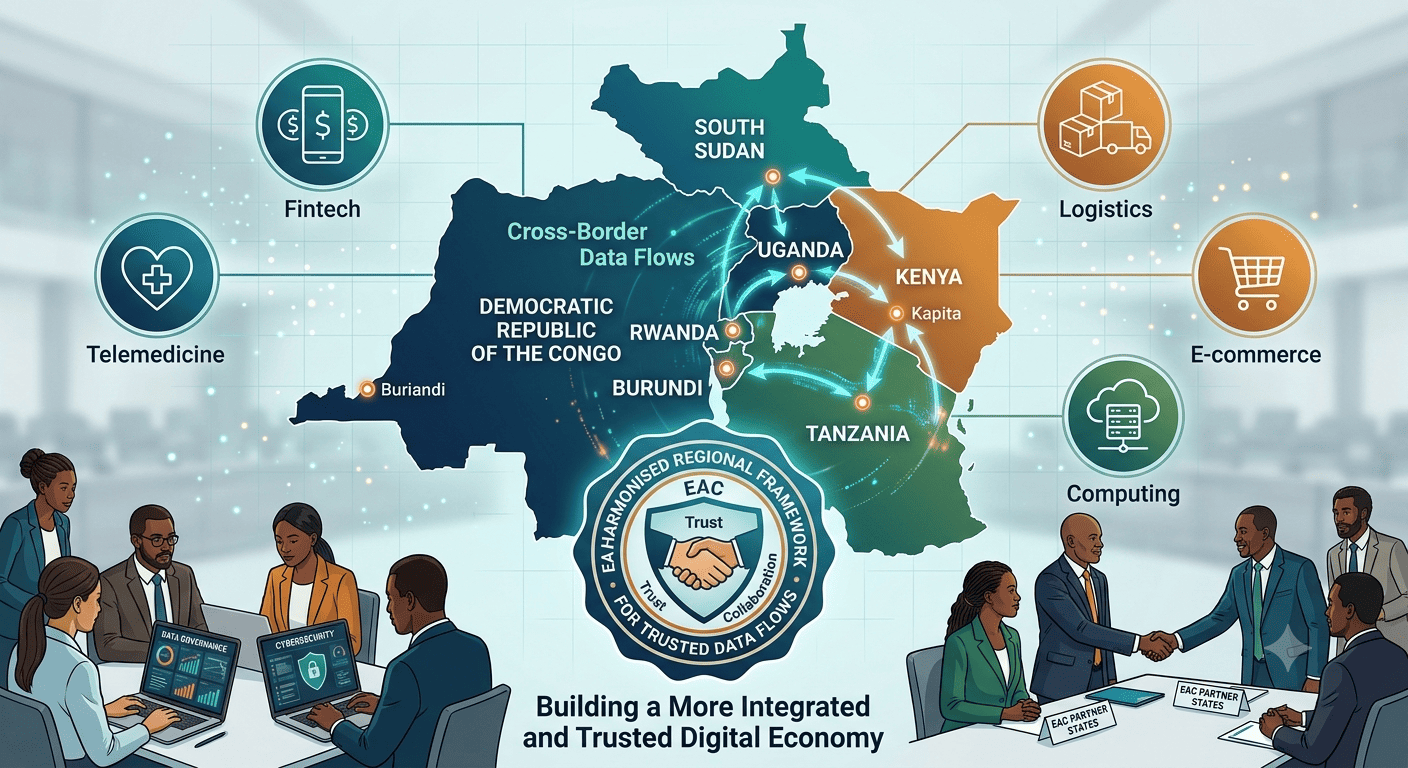
The East African Community (EAC) has taken a significant step towards building a more integrated and trusted digital economy following the approval of a harmonised Regional Framework for Trusted Cross-Border Data Flows by technical experts meeting in Dar es Salaam.
The validation of the framework by the Fourth Meeting of the EAC Technical Working Group on Data Protection and Cybersecurity Harmonised Frameworks signals growing regional recognition that data has become a critical enabler of trade, innovation, financial inclusion and public service delivery. The framework now proceeds to the next stage of legislative development, where EAC policy organs and Partner States will consider it for formal adoption.
Why This Matters
Cross-border data flows are the backbone of today’s digital economy. Every cross-border payment, online purchase, cloud-based service, telemedicine consultation, logistics operation, or digital identity verification depends on the ability to transfer information securely across jurisdictions.
Yet businesses operating across East Africa currently face a fragmented regulatory landscape. While most EAC Partner States have enacted data protection legislation, differences in legal requirements, transfer mechanisms, regulatory oversight and compliance obligations often create uncertainty and increase the cost of doing business.
A harmonised regional framework seeks to address these challenges by establishing common principles that facilitate the trusted movement of data while ensuring that individuals’ personal data remains protected.
Rather than replacing national data protection laws, the proposed framework introduces minimum regional standards that promote interoperability between legal systems while respecting the sovereignty of each Partner State.
Building Trust in the Digital Single Market
The framework has the potential to become a foundational pillar of the EAC’s vision for a Digital Single Market.
Sectors expected to benefit include:
- Financial services and mobile money
- Digital payments and fintech
- Healthcare and telemedicine
- Higher education and research
- Logistics and supply chain management
- E-commerce
- Cloud computing
- Artificial intelligence
- Government digital services
For organisations operating across multiple EAC jurisdictions, harmonised rules could reduce compliance complexity, improve legal certainty and accelerate regional digital transformation.
Consumers also stand to benefit from stronger safeguards, greater transparency and increased confidence that their personal information will receive consistent protection regardless of where it is processed within the region.
Balancing Innovation with Privacy
One of the most notable aspects of the proposed framework is its emphasis on balancing economic growth with the protection of fundamental privacy rights.
According to the EAC discussions, the framework is intended to enable trusted data sharing without undermining national sovereignty. This reflects an increasingly important principle in modern data governance: interoperability rather than uniformity.
Many regional initiatives around the world have demonstrated that successful cross-border data governance does not require identical legislation. Instead, countries can recognise common standards, shared safeguards and mutually trusted regulatory mechanisms while maintaining their domestic legal frameworks.
This approach provides flexibility for Partner States while supporting regional integration.
The Importance of Practical Implementation
The recommendation to undertake a regional pilot involving both public and private sector organisations, including Micro, Small and Medium Enterprises (MSMEs), is particularly encouraging.
Implementation often presents the greatest challenge in regional regulatory initiatives. Piloting the framework allows regulators and businesses to identify operational challenges, refine guidance and develop practical compliance models before wider adoption.
Equally important is the commitment to capacity building for regulators, government institutions and businesses. Effective data governance requires more than legislation. It depends on institutional capability, organisational readiness and a shared understanding of privacy obligations across the ecosystem.
A Proud Moment for Data Governance Africa
The successful validation of the proposed Cross-Border Data Flows Framework is also a proud milestone for Data Governance Africa. Our Founder, Ian Olwana, was the privacy expert consultant supporting the East African Community Technical Working Group on Data Protection and Cybersecurity Harmonised Frameworks that validated the proposed framework.
Over the past 6 months, Ian contributed to refining the principles underpinning the framework by helping incorporate feedback and perspectives from all EAC Partner States. Working alongside experts from across the region, he supported the development of a balanced approach that reconciles differing legal, regulatory and policy frameworks while preserving national sovereignty and promoting trusted cross-border data flows.
The validation of the framework represents more than a technical achievement. It demonstrates the power of regional collaboration in developing practical governance solutions that can unlock digital trade, strengthen privacy protections and build trust across East Africa’s digital ecosystem. For Data Governance Africa, it reflects our mission of contributing to policy development and advancing trusted, responsible and interoperable data governance across the continent.
What Businesses Should Do Now
Although the framework has not yet entered into force, organisations operating across East Africa should begin preparing for greater regional alignment by:
- Reviewing current cross-border data transfers.
- Maintaining comprehensive records of processing activities and data flows.
- Strengthening technical and organisational security measures.
- Reviewing contracts governing international data transfers.
- Conducting Data Protection Impact Assessments (DPIAs) for high-risk processing activities.
- Monitoring developments as the framework progresses through the EAC legislative process.
Early preparation will position organisations to take advantage of future opportunities while reducing compliance risks.
Looking Ahead
The approval of the proposed Cross-Border Data Flows Framework represents more than a regulatory milestone. It reflects a broader shift towards recognising data governance as a strategic enabler of regional economic integration.
If ultimately adopted by EAC Ministers and Partner States, the framework could significantly improve legal certainty for businesses, strengthen trust in digital services and support innovation across East Africa’s rapidly growing digital economy.
For policymakers, regulators and organisations alike, the next phase will be critical. Success will depend not only on the adoption of harmonised standards but also on effective implementation, sustained collaboration and continued investment in data governance capabilities.
As East Africa continues its digital transformation journey, trusted cross-border data flows will increasingly become a cornerstone of regional competitiveness, economic growth and citizen trust.