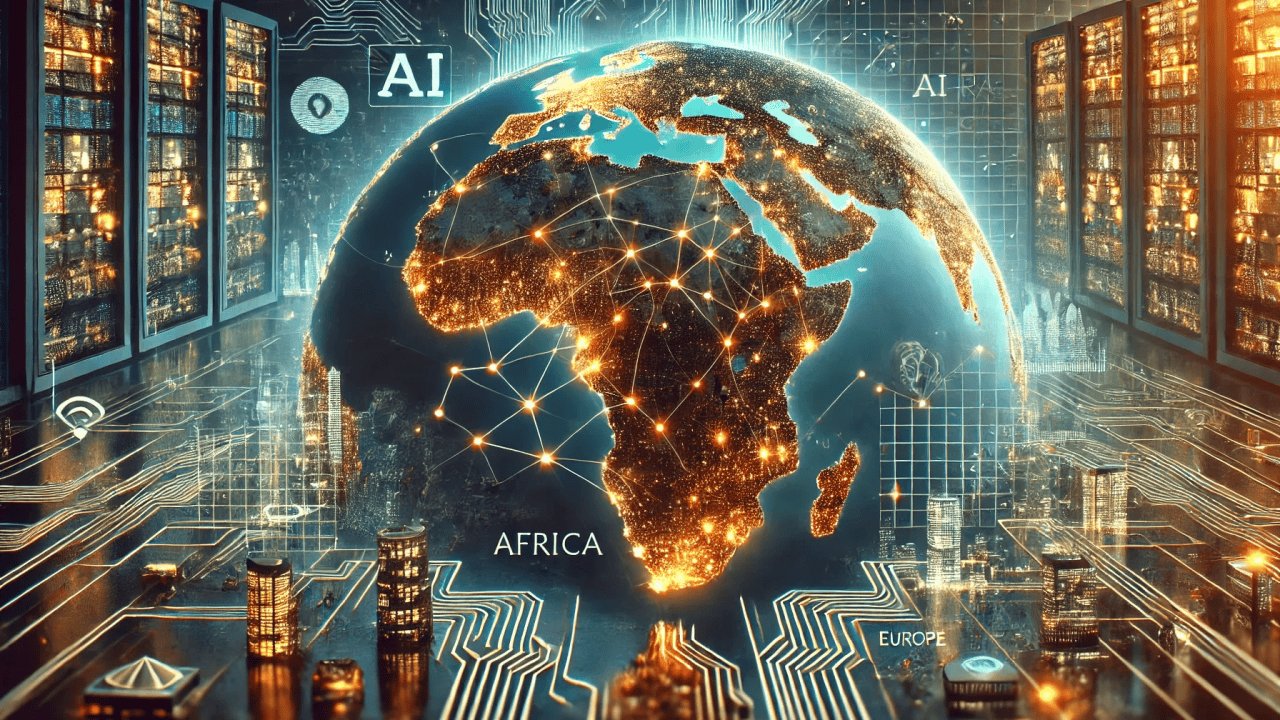
A recent debate among Kenyan data governance professionals raised a fundamental question: Can Africa truly compete in the global AI race, or should the continent focus first on building the foundations that will make meaningful participation possible?
The question goes beyond technology. As AI increasingly reshapes economic and geopolitical power, the ability to develop, deploy and control advanced AI systems is becoming a strategic asset.
The rivalry between OpenAI and DeepSeek illustrates this shift. DeepSeek’s emergence with comparatively low-cost, capable AI models challenged assumptions about the computing resources required to compete at the frontier. The announcement triggered a major sell-off in technology stocks, with Nvidia losing nearly $600 billion in market value in a single day.
The episode underscored a reality that African policymakers cannot afford to ignore: AI is no longer simply a technological race. It is increasingly a contest over economic power, strategic autonomy and geopolitical influence.
Africa’s AI Challenge: More Than a Technology Gap
Africa has significant potential to benefit from AI, but the continent faces structural constraints that cannot be solved by simply adopting the latest models.
Limited computing capacity, unreliable electricity, inadequate digital infrastructure and constrained investment all make it difficult for African countries to build and scale AI systems. The shortage of data centres and high-performance computing infrastructure is particularly significant. Without access to reliable computational resources, African researchers, startups and governments risk remaining consumers of AI developed elsewhere rather than becoming meaningful producers.
This raises a strategic question.
Should African countries attempt to compete directly with the United States and China in frontier AI development, despite these infrastructure gaps? Or should they first build the foundations that allow the continent to participate on its own terms?
The answer does not have to be either-or. Africa can pursue AI innovation while simultaneously investing in the infrastructure, skills, energy systems and institutions required to sustain it.
The EU’s Regulatory Model: A Lesson for Africa?
The European Union offers one possible lesson. Rather than treating AI development as purely a race for technological supremacy, the EU has placed considerable emphasis on governance, risk management, accountability and fundamental rights through its AI regulatory framework.
Africa should draw lessons from this approach without simply copying the European model.
Strong governance can create the conditions for trustworthy AI. Clear rules can provide businesses with greater certainty, while safeguards can help protect citizens from discriminatory, unsafe or otherwise harmful automated decisions.
But regulation alone will not solve Africa’s AI challenge.
There is little value in creating sophisticated AI rules if governments, businesses and researchers lack the infrastructure and technical capacity to implement them. Regulation must therefore develop alongside investment in computing, electricity, data infrastructure, research and skills.
The objective should not be to regulate AI out of existence. It should be to build an ecosystem in which innovation can scale without sacrificing public interest.
Beyond AI Models: Africa’s Semiconductor Opportunity
Africa’s role in the AI economy also does not have to begin and end with developing foundation models.
The continent possesses significant reserves of critical minerals that are essential to modern technology and semiconductor supply chains. Yet Africa remains largely positioned at the lower end of these value chains, exporting raw materials while much of the processing, manufacturing and technological value creation takes place elsewhere.
That is a strategic vulnerability.
Semiconductors underpin the computing infrastructure required for AI. By investing in mineral processing, electronics manufacturing, semiconductor research and related supply chains, African countries could capture a greater share of the value generated by the AI economy.
This would require substantial investment, technical expertise and long-term industrial policy. But the potential payoff is much larger than simply trying to replicate Silicon Valley.
Africa could instead identify strategic points in the AI value chain where it has genuine comparative advantages and build capabilities around them.
A Strategic Approach to Africa’s AI Future
Africa should not approach AI as a race in which success means building the biggest model or attracting the largest AI company.
The more important question is whether the continent can develop the capacity to control, adapt and benefit from the technologies that will shape its future.
That requires at least three priorities:
- Build effective governance: Develop regulatory and institutional frameworks that promote innovation while protecting rights, accountability and public interest.
- Invest in infrastructure: Expand reliable electricity, data centres, connectivity, cloud and high-performance computing capacity.
- Move up the technology value chain: Invest in critical-mineral processing, semiconductor manufacturing, electronics and other strategic components of the AI supply chain.
- Develop African technical capacity: Strengthen universities, research institutions, startups and technical talent so that Africa is not permanently dependent on foreign expertise and infrastructure.
The goal should not be to abandon the AI race.
It should be to choose where Africa can compete, build the foundations required to compete effectively, and ensure that the value created by AI is not simply extracted from the continent.
Africa’s AI future will ultimately depend less on how quickly it can imitate today’s global AI leaders and more on whether it can build the infrastructure, institutions and industrial capacity needed to shape tomorrow’s AI economy.