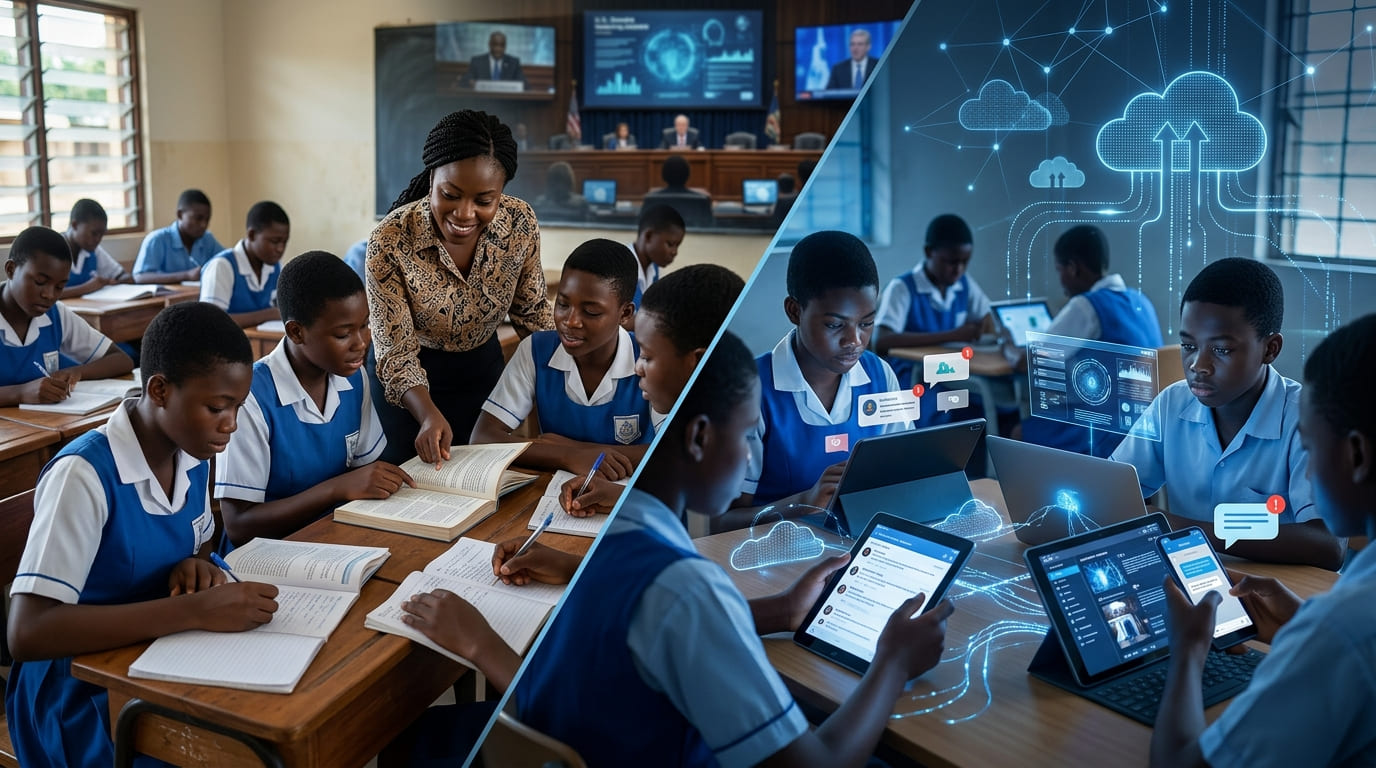
When the U.S. Senate Committee on Commerce, Science, and Transportation convened its January 2026 hearing, “Plugged Out: Examining the Impact of Technology on America’s Youth,” the central question was not whether technology belongs in children’s lives. It was whether society had become too willing to assume that more technology automatically means better outcomes.
The hearing brought together psychologists, paediatricians, educators and technology experts to examine what smartphones, social media, laptops and educational technology are doing to children’s learning, mental health and development.
Among the witnesses was cognitive neuroscientist Dr. Jared Cooney Horvath, whose testimony delivered a particularly uncomfortable message for education systems pursuing rapid digital transformation: the expansion of educational technology has not necessarily produced better learning.
Horvath argues that cognitive development across much of the developed world has stalled or reversed in several areas, including literacy, numeracy, attention and higher-order reasoning. At the same time, classrooms have undergone a dramatic technological transformation, with one-to-one laptops and tablets, cloud platforms, online assessments and educational software becoming increasingly common.
His warning is not that technology has no place in education. Rather, it is that technology should be treated as an educational intervention that must prove its value, not as an unquestioned measure of educational progress.
That distinction matters enormously for Africa.
Table of Contents
- The Digital Education Paradox
- What Horvath’s Evidence Says
- The Problem Is Not the Screen Alone
- Paper, Screens and the Depth of Learning
- From Learning Technology to Attention Technology
- The Data Governance Problem
- Africa’s Race to Digitise
- The Risk of Digitising the Learning Crisis
- The Inequality Question
- What Africa Should Learn From the Senate Debate
- From Digital Transformation to Cognitive Sovereignty
- The Race Should Not Be to Digitise First
The Digital Education Paradox
Africa is rightly investing in digital infrastructure.
Across the continent, governments and development partners are pursuing school connectivity, digital learning platforms, teacher technology training, online education, digital skills programmes and technology-enabled classrooms. UNESCO’s ICT Transforming Education in Africa programme, for example, has supported digital pedagogical transformation across countries including Mozambique, Rwanda, Zimbabwe, Cote d’Ivoire, Ghana and Senegal, with its current phase focusing on Namibia, Tanzania and Uganda.
The World Bank is similarly supporting digital transformation across Eastern and Southern Africa, where digitalisation is seen as an important pathway to jobs, improved services and inclusion. The region’s digital agenda includes expanding connectivity, devices, digital skills and digitally enabled services.
There is therefore a compelling reason for Africa to embrace technology. Millions of African children still lack access to quality teachers, textbooks, libraries, laboratories and other educational resources. Digital tools can potentially help overcome some of these constraints. They can extend access to learning materials, connect students to teachers, support children with disabilities, enable distance learning and provide opportunities that would otherwise be unavailable.
But this creates a dangerous policy temptation: if Africa has too little educational technology, perhaps the answer is simply to buy more of it.
The Senate testimony challenges that assumption. Increasing technology adoption should not itself be treated as evidence of educational progress. The real question should be:
Does a particular technology measurably improve learning in the African context, and at what cognitive, financial, privacy and social cost?
What Horvath’s Evidence Says
Horvath’s testimony draws on international assessments, meta-analyses and cognitive research.
One of the most important datasets he discusses is the OECD’s Programme for International Student Assessment (PISA). According to his analysis, higher levels of classroom computer use are consistently associated with lower reading, mathematics and science scores. Similar patterns appear in TIMSS and PIRLS data.
The important word here is associated. These datasets do not, by themselves, establish that screens are the sole cause of declining achievement. But they challenge the assumption that increasing digital exposure automatically produces better educational outcomes.
Horvath’s meta-analysis discussion is even more provocative.
His testimony examines 398 meta-analyses covering more than 21,000 individual studies. When digital interventions are compared against established classroom instruction and the effect is recalibrated against the estimated impact of ordinary teaching, general educational technology falls below that benchmark. One-to-one laptop programmes show a particularly negative adjusted effect in his analysis.
The finding does not mean that every educational technology product fails. Some narrowly designed technologies, particularly tools providing adaptive practice or targeted remediation, can be useful. The distinction is between technology designed to solve a specific learning problem and technology introduced simply because digitalisation is considered inherently progressive.
That distinction should become central to African education policy.
The Problem Is Not the Screen Alone
One of Horvath’s most important arguments concerns how digital environments interact with human attention.
Human attention is limited. Repeated task switching creates time costs, increases cognitive interference and can weaken memory formation. Digital platforms, meanwhile, are often designed around rapid switching, novelty and continuous engagement.
Even when the device is being used for schoolwork, the same environment can encourage checking, scrolling and multitasking. This helps explain why the distinction between a “school device” and a “recreational device” may be less meaningful than policymakers assume.
A tablet does not become cognitively harmless because it has an education department’s logo on it. A laptop does not automatically become a learning tool because it was purchased through a school programme. An educational app is not necessarily educational simply because its marketing says so.
Paper, Screens and the Depth of Learning
The testimony also raises concerns about the medium through which children encounter information.
Horvath cites research showing stronger comprehension and retention when complex material is read on paper rather than on screens. His testimony also points to evidence that handwritten note-taking can outperform laptop note-taking because handwriting requires students to summarise and organise information rather than simply transcribe it.
This matters because digital transformation can quietly change what learning looks like.
A child reading a printed chapter may sit with one argument for twenty minutes. A child reading the same material on an internet-connected device may encounter notifications, hyperlinks, videos, advertisements, messages and recommendations before finishing the first page.
The problem is therefore not merely “screen time.” It is the architecture surrounding the screen.
From Learning Technology to Attention Technology
This is where the testimony of paediatrician Dr. Jenny Radesky becomes particularly important.
Radesky argues that children’s technology environments are often built around commercial incentives rather than developmental needs. Her research found that 99% of the high-duration children’s apps she examined contained at least one manipulative design intended to prolong gameplay, encourage purchases or increase interaction with advertising.
She also found that many apps marketed as educational performed poorly when evaluated against established principles of learning, with distracting features and advertising further reducing quality in some cases.
This creates an important governance question:
Who is the technology actually designed to serve, the learner or the engagement economy?
If an education platform is rewarded for keeping children online for longer, then “engagement” can quietly become a substitute for learning. A child who spends an hour inside an application may look highly engaged on a dashboard, but engagement is not the same as comprehension, and screen time is not the same as learning time.
The Data Governance Problem
There is another dimension that deserves much more attention in Africa: children’s data.
When a country introduces digital learning at scale, it is not simply introducing computers into classrooms. It is creating a new infrastructure for collecting, processing, analysing and potentially sharing information about children.
A digital learning platform can generate student profiles, learning histories, assessment results, behavioural data, device identifiers, location information and interaction patterns. Where platforms incorporate artificial intelligence, they may also generate inferred profiles about a child’s abilities, learning behaviour or likely educational needs.
This is where educational technology becomes a data governance issue.
Radesky’s research into apps used by preschool children found that 67% of the Android apps examined transmitted persistent identifiers to as many as 33 third-party domains, including advertising networks and data brokers. The finding illustrates a broader concern: children can begin generating persistent digital footprints long before they have the capacity to understand what those footprints mean or how they may be used.
For African education systems, the appropriate response cannot simply be to add a privacy policy to a procurement contract. Privacy and child protection need to be built into the architecture of educational technology from the beginning.
Kenya provides a useful example. The Data Protection Act, 2019 establishes principles including purpose limitation, data minimisation, transparency and storage limitation. It also regulates transfers of personal data outside Kenya. The Office of the Data Protection Commissioner has specifically recognised children as vulnerable data subjects and states that processing sensitive personal data relating to children that is likely to create high risks to their rights and freedoms requires a Data Protection Impact Assessment (DPIA).
That has practical implications for a school or education ministry procuring a digital learning platform. A DPIA should not be treated as paperwork completed after a vendor has already been selected. It should form part of the decision about whether the technology should be deployed at all.
What data will the platform collect? Is each category necessary for learning? Who will have access? How long will the information be retained? Will children be profiled? Can the vendor use the information for product development, advertising or other secondary purposes? Where will the data be stored? And what happens when the contract ends?
The same questions become more complicated when the platform is hosted outside the country.
Kenya’s framework requires appropriate safeguards for international transfers where adequate protection is not established. For education platforms serving African children, this matters because the technology stack may span several jurisdictions. A school may be in Nairobi, the education ministry may be in Kenya, the platform provider may be headquartered in another country, the cloud infrastructure may sit in a third country and analytics or artificial intelligence services may be supplied by yet another company.
The child may be local. The data infrastructure may not be.
Nigeria’s data protection framework similarly provides mechanisms for cross-border transfers, including adequacy decisions and approved transfer instruments. Its regulatory framework also places obligations on organisations using data processors, including due diligence and appropriate contractual arrangements.
The GDPR provides another useful reference point for African policymakers, particularly where European providers or learners are involved. It requires DPIAs for processing likely to result in high risks, including systematic profiling and large-scale processing of sensitive data. It also provides specific safeguards for children’s data and imposes conditions on transfers of personal data outside the European Economic Area.
These different frameworks point toward a common principle: digital education procurement should increasingly be treated as a privacy-by-design exercise.
Before a government buys 100,000 tablets or signs a contract with an educational platform, it should be asking not only whether the technology improves examination results, but also whether it is proportionate, secure, necessary and accountable.
The central governance questions are therefore:
Why is the data being collected? What can be inferred from it? Who controls it? Where does it go? How long does it remain there? And what rights does a child have over it?
These questions are particularly important because children’s educational records can follow them for years. A temporary classroom technology decision can therefore create a permanent digital record.
The objective of educational digitalisation should be to give children better tools for learning, not to create better tools for monitoring children.
Africa’s Race to Digitise
This is where the Senate testimony becomes particularly relevant to Africa.
Africa is confronting a genuine education crisis. UNESCO reports that only 10.8% of children in the countries covered by its 2025 Spotlight report sample achieve minimum proficiency in reading and mathematics by the end of primary school.
At the same time, the continent is pursuing ambitious digital education programmes.
The World Bank says that more than 94% of its education projects globally included an EdTech component as of 2025. Its Africa strategy also recognises technology as one component of transforming learning spaces, while emphasising that access alone is insufficient and that teacher quality, teaching materials, curriculum and effective instruction remain critical.
This creates a paradox for African policymakers. The continent needs better education, stronger digital infrastructure and greater digital skills, but that does not mean more screens will automatically produce better learning.
Africa does not necessarily need more screens simply because screens are available.
The danger is that technology becomes a visible proxy for progress. A classroom with tablets can look modern. A classroom with fast internet can look innovative. A digital dashboard can produce impressive numbers.
But none of these proves that a child has learned to read, reason, calculate, write, create or think critically.
The Risk of Digitising the Learning Crisis
This is perhaps the most important lesson for African policymakers.
If the underlying problem is inadequate foundational learning, adding technology without fixing pedagogy can simply digitise the existing problem.
If children cannot read effectively from paper, moving the text onto a tablet does not solve the literacy problem.
If teachers lack adequate training, giving every teacher a laptop does not automatically improve instruction.
If classrooms are overcrowded, an educational platform does not remove the need for effective teachers.
If children lack electricity and reliable connectivity, a cloud-based learning system can deepen rather than eliminate inequality.
And if schools deploy technology without strong privacy safeguards, the cost of digital education may eventually include a generation of children whose behavioural and educational histories have been extensively profiled.
Africa’s digital divide could therefore become more complicated. The question may no longer be simply who has a device? It may become who has a device that supports meaningful learning, who has the skills to use it, who controls the data, and who benefits from the resulting digital ecosystem?
The Inequality Question
The African context also requires caution because technology is rarely introduced into equal environments.
The World Bank notes that Eastern and Southern Africa continues to face uneven internet availability, affordability challenges, device costs and significant gaps in digital access.
During Kenya’s COVID-era school closures, for example, remote-learning efforts exposed a significant digital divide, with more than half of students reportedly left out because of inadequate devices, electricity or internet connectivity.
This means that poorly designed digital education can create two different forms of inequality.
The first is access inequality: some children have devices, connectivity and digital learning resources while others do not.
The second is quality inequality: some children may receive carefully designed, teacher-supported digital learning, while others receive low-quality applications, uncontrolled internet access and technology that primarily captures attention.
Digitalisation does not automatically eliminate inequality. It can redistribute it.
What Africa Should Learn From the Senate Debate
The answer is not to abandon digital education. Doing so would be unrealistic and potentially counterproductive.
Technology can provide enormous benefits when it is purposeful, accessible, evidence-based and appropriately governed. Radesky herself notes that children with specific learning needs can benefit from assistive technologies such as specialised reading programmes, speech-to-text and word-processing tools.
The lesson is therefore not “technology versus traditional education.” It is “evidence before scale.”
That means African governments, donors and education ministries should consider at least seven principles.
1. Stop measuring digitalisation by device numbers
The number of tablets distributed is an input, not an educational outcome.
Success should be measured through reading, numeracy, comprehension, retention, problem-solving and other meaningful learning outcomes.
2. Demand independent evidence before procurement
Horvath recommends independent, replicated evidence before publicly funded EdTech is deployed at scale.
African governments should apply the same principle. Before spending millions on an educational platform, policymakers should ask:
Does it work? For whom? Under what conditions? Compared with what? And for how long?
3. Protect the developmental value of analogue learning
Children still need books, handwriting, physical play, conversation, experimentation, creativity and face-to-face interaction.
Digital education should supplement these activities, not automatically replace them.
Radesky specifically argues that one-to-one devices are not necessary throughout the day for younger children and recommends developmentally appropriate, supervised use.
4. Make children’s data a governance issue
Educational technology procurement should include privacy impact assessments, clear data retention rules, limits on profiling, restrictions on secondary use, transparent vendor practices and strong safeguards for children’s information.
A free educational platform is not necessarily free if the price is a child’s behavioural data.
5. Design for African realities
African digital education cannot simply import platforms designed for entirely different educational, linguistic, cultural and infrastructural environments.
Technology must account for local languages, connectivity limitations, teacher capacity, electricity availability, accessibility and curriculum requirements.
6. Preserve the teacher’s role
The objective should be to make teachers more effective, not to use technology as a substitute for teachers.
Digital tools should reduce administrative burdens, provide useful resources and support differentiated learning where evidence demonstrates value.
7. Treat attention as a protected resource
If education is fundamentally about developing the capacity to concentrate, reason and remember, then educational technology should not be allowed to undermine those capabilities.
Technology used in schools should therefore be designed around learning rather than engagement.
From Digital Transformation to Cognitive Sovereignty
There is an even deeper issue here.
Africa is currently debating digital sovereignty in areas such as data, cloud infrastructure, artificial intelligence, digital public infrastructure and cross-border data flows. Education should be part of that conversation.
If African children increasingly learn through platforms developed elsewhere, hosted elsewhere, governed elsewhere and generating data that flows elsewhere, then the continent is not merely importing technology. It may be importing the architecture through which future generations learn, think and interact with information.
For Africa, this makes educational technology part of the broader strategic debate over digital sovereignty. The platforms through which children learn can also determine where their data goes, who controls it and which external technologies shape their educational experience.
The question is not whether Africa should participate in the digital economy. It absolutely should. The question is whether Africa will have sufficient agency to determine what kind of digital economy and what kind of digital education it builds.
The Race Should Not Be to Digitise First
The Senate testimony offers a useful warning precisely because it comes from a country that has already travelled further down the road of large-scale technology adoption in education.
America’s experience suggests that once devices become embedded in classrooms, reversing course becomes politically, financially and institutionally difficult.
Africa still has an opportunity to learn before making the same mistakes at scale.
That does not mean rejecting tablets, laptops, AI, online learning or digital platforms. It means refusing to confuse digital access with educational progress.
The continent’s education challenge is too important to become a market for untested technology. And Africa’s children are too important to become the raw material for another attention economy.
The goal should not be to maximise the amount of technology a child encounters. It should be to maximise what that child is capable of understanding, remembering, creating and questioning.
Horvath’s conclusion captures the broader principle: the objective of education policy should not be to maximise screen exposure, but to maximise the cognitive capacity and long-term flourishing of the next generation.
For Africa, that means entering the digital age with a different question:
How can we use technology without sacrificing the human capabilities education exists to build?
That may be the difference between simply digitising African education and genuinely transforming it.